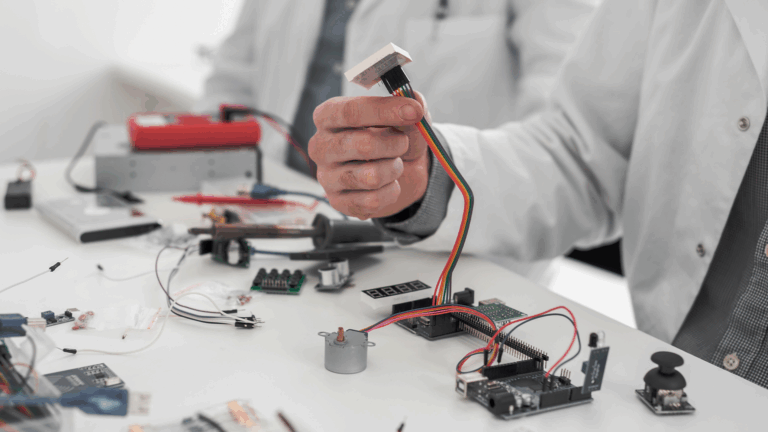

There are dozens of technical terms and definitions used in Electromagnetic Compatibility (EMC) and wireless compliance testing. From emissions and immunity to surge, ESD, RF bandwidth, detector types, and advanced modulation methods, understanding these terms is essential for engineers, product designers, and compliance managers.
This complete glossary supports preparation for certification and global market access through professional EMC testing services, RF testing services, radiated emission testing, conducted emission testing, radiated immunity testing, and ESD testing.
Alternating Current (AC)
Alternating Current is electrical current that periodically reverses direction as it flows through a circuit. Most industrial and residential power systems operate using AC, and conducted emissions testing evaluates disturbances on AC mains lines.
Direct Current (DC)
Direct Current flows in a single direction and is common in battery-powered electronics and DC power ports. EMC compliance testing evaluates emissions and immunity behavior on DC supply interfaces.
AC/DC
AC/DC refers to power systems that convert alternating current into direct current. These converters are commonly evaluated during conducted emission testing and radiated emission testing.
Equipment Under Test (EUT)
The Equipment Under Test is the product being evaluated during EMC or RF compliance assessment. All disturbances, emissions measurements, and immunity stresses are applied directly to the EUT.
Unit Under Test (UUT)
Unit Under Test is another term used interchangeably with EUT. It is widely used in wireless certification and laboratory documentation.
Auxiliary Equipment (AE)
Auxiliary Equipment supports the EUT during testing to simulate real-world operation. It ensures the product functions normally while compliance measurements are performed.
Electromagnetic Compatibility (EMC)
EMC is the ability of a device to operate correctly in its electromagnetic environment without introducing intolerable interference. Achieving EMC compliance is mandatory for global product commercialization.
Electromagnetic Interference (EMI)
EMI refers to unwanted electromagnetic disturbances generated by electronic equipment. It is evaluated through radiated and conducted emissions testing.
Calibration
Calibration is the process of comparing test equipment against known traceable standards. It ensures measurement accuracy and regulatory defensibility.
Verification
Verification confirms that the test system is functioning within required specifications. It is performed before formal compliance measurements begin.
Measurement Uncertainty (MU)
Measurement Uncertainty quantifies the doubt associated with a test result. Regulatory standards require uncertainty evaluation to validate compliance decisions.
Resolution Bandwidth (RBW)
Resolution Bandwidth defines the frequency filter width used during emissions measurement. It directly impacts signal resolution and noise floor.
Video Bandwidth (VBW)
Video Bandwidth applies post-detection filtering to smooth measurement traces. It reduces fluctuations during spectrum analysis.
Voltage Standing Wave Ratio (VSWR)
VSWR measures impedance matching quality in RF systems. Poor matching can cause signal reflections and affect RF compliance results.
LISN (Line Impedance Stabilization Network)
A LISN provides standardized impedance during conducted emission testing. It isolates external disturbances and couples emissions to the measuring receiver.
Antenna
An antenna converts electromagnetic fields into measurable electrical signals or radiates RF energy during immunity testing. It is essential in radiated emission and radiated immunity evaluations.
Antenna Factor
Antenna factor converts measured voltage into actual field strength values. Proper calibration ensures regulatory accuracy.
EMI Receiver
An EMI receiver complies with CISPR bandwidth and detector requirements. It ensures standardized emission measurements across laboratories.
Peak Detector
The peak detector measures the highest instantaneous amplitude within a frequency sweep. It is commonly used during pre-compliance scans.
Quasi-Peak Detector
The quasi-peak detector weights signals based on repetition rate. It penalizes frequent disturbances and is required in many CISPR standards below 1 GHz.
Average Detector
The average detector calculates time-averaged emission levels. It is typically required above 1 GHz for compliance confirmation.
RMS (Root Mean Square)
RMS represents the effective value of a varying waveform. It is commonly used in RF power calculations and immunity testing.
Electrostatic Discharge (ESD)
ESD is the transfer of static electricity between objects at different potentials. ESD testing evaluates product resilience to human body discharge events.
Air Discharge Method
In the air discharge method, a charged electrode approaches the EUT until discharge occurs. It simulates real-world static events.
Contact Discharge Method
In the contact discharge method, the electrode touches the EUT before discharge is triggered. It provides more repeatable results.
Direct Application
Direct application refers to applying the ESD pulse directly to the EUT surface.
Indirect Application
Indirect application applies discharge to a coupling plane near the EUT.
Coupling Plane (HCP / VCP)
Coupling planes are metallic surfaces used during indirect ESD testing to simulate nearby conductive structures.
Surge
A surge is a high-energy transient voltage or current spike caused by lightning or switching events.
Combination Wave Generator (CWG)
A CWG produces standardized surge voltage and current waveforms required for IEC 61000-4-5 compliance.
Electrical Fast Transient / Burst (EFT/B)
EFT/B simulates repetitive fast switching disturbances found in industrial environments.
Rise Time
Rise time measures how quickly a transient increases from 10% to 90% of peak amplitude.
Pulse Width
Pulse width defines the duration of a transient measured at 50% amplitude.
99 Percent Occupied Bandwidth
This defines the frequency range containing 99% of transmitted RF energy.
26 dB Bandwidth
The 26 dB bandwidth measures signal width 26 dB below peak amplitude.
Equivalent Isotropically Radiated Power (EIRP)
EIRP represents total radiated power referenced to an ideal isotropic antenna.
Effective Radiated Power (ERP)
ERP references radiated power to a half-wave dipole antenna.
Out Of Band (OOB)
Out-of-band emissions occur outside the assigned operating frequency band.
Power Spectral Density (PSD)
PSD measures power distribution across frequency.
Frequency Hopping Spread Spectrum (FHSS)
FHSS rapidly switches frequencies to reduce interference.
Direct Sequence Spread Spectrum (DSSS)
DSSS spreads signal energy across wide bandwidth using coded sequences.
Orthogonal Frequency Division Multiplexing (OFDM)
OFDM divides data across multiple orthogonal subcarriers for efficient spectrum use.
MIMO (Multiple Input Multiple Output)
MIMO uses multiple antennas simultaneously to improve wireless performance and reliability.
Related Articles