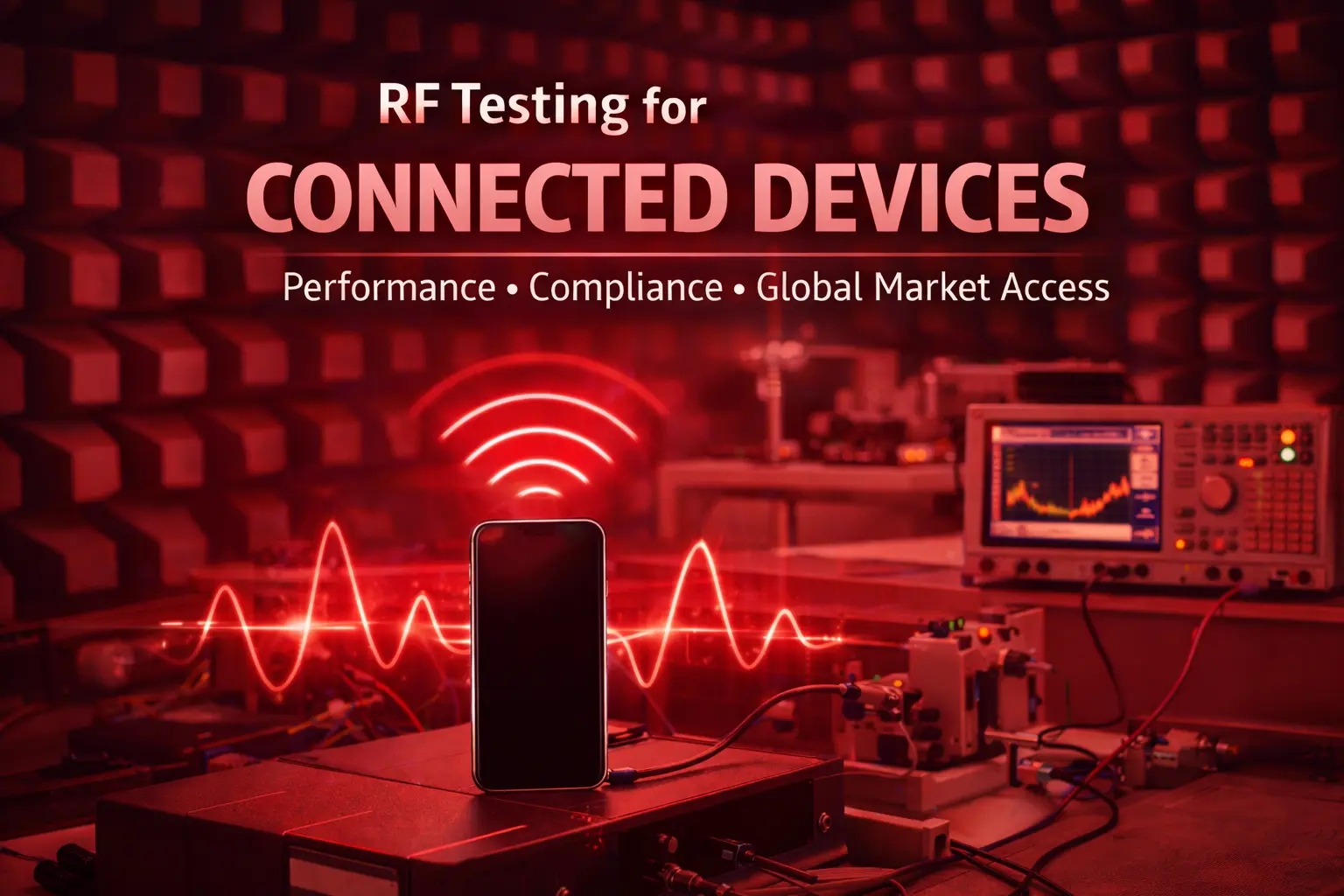
Wireless technologies are now embedded in a vast range of products, from IoT devices and industrial equipment to medical devices, automotive systems, and consumer electronics. As radio-enabled products continue to proliferate, Radio Frequency (RF) testing has become a critical requirement to ensure reliable operation, regulatory compliance, and safe coexistence with other wireless systems.
RF testing validates that a device’s radio functions operate within defined technical and regulatory limits, enabling manufacturers to bring compliant and high-performance products to global markets with confidence.
What Is RF Testing?
RF testing evaluates the performance and regulatory compliance of products that intentionally transmit or receive radio signals. Unlike general EMC testing, which focuses on unintended electromagnetic emissions and immunity, RF testing concentrates specifically on intentional radiators and their radio characteristics.
Typical RF evaluations include:
-
Transmitter output power and power control
-
Occupied bandwidth and spectral mask compliance
-
Spurious and harmonic emissions
-
Modulation accuracy and signal quality
-
Receiver sensitivity and blocking
-
Wireless coexistence and interference robustness
These tests confirm that a wireless device uses the radio spectrum efficiently and does not create harmful interference to other systems operating in the same environment.
RF Testing vs. EMC Testing
Although closely related, RF testing and EMC testing serve different but complementary purposes:
-
EMC testing: verifies that a product does not generate excessive electromagnetic disturbances and remains immune to external electromagnetic phenomena.
-
RF testing: validates the intended radio behavior of wireless transmitters and receivers in accordance with regional radio regulations.
Most wireless products require both EMC and RF testing to demonstrate full regulatory compliance before market entry.
Regulatory Frameworks and Standards
RF testing is performed in accordance with internationally recognized regulatory and technical standards, depending on the target market and technology used. Common regulatory frameworks include:
-
FCC (United States)
-
ISED (Canada)
-
CE / RED (European Union)
-
ETSI EN standards for radio equipment
-
Country-specific requirements for Asia-Pacific, Middle East, and Latin America
Accredited laboratories follow strict test procedures and measurement uncertainty controls to ensure results are accepted by certification bodies and authorities worldwide.
What RF Testing Involves
Transmitter Testing
These tests confirm that the device transmits within permitted limits for power, bandwidth, and emissions. Excessive power or out-of-band emissions can cause interference with nearby wireless systems and lead to regulatory non-compliance.
Receiver Performance Testing
Receiver tests evaluate how effectively a device detects and processes weak signals in the presence of noise or interference. This directly impacts wireless reliability, range, and user experience.
Spurious and Harmonic Emissions
RF testing ensures that unintended emissions outside the assigned frequency band remain below regulatory thresholds, protecting adjacent spectrum users.
Coexistence and Functional Performance
In increasingly crowded RF environments, devices must continue to function correctly alongside other wireless technologies. RF testing assesses resilience to interference and real-world operating conditions.
Why RF Testing Is Critical
-
✔ Regulatory Approval and Market Access: Wireless products cannot be legally sold without demonstrating compliance with applicable RF regulations. Successful RF testing supports certification and market entry across multiple regions.
-
✔ Reliable Wireless Performance: RF testing verifies key parameters that influence connection stability, data integrity, range, and battery efficiency.
-
✔ Reduced Risk and Faster Time-to-Market: Identifying RF issues early in development minimizes redesign cycles, avoids certification delays, and reduces overall project risk.
-
✔ Protection of Brand and Reputation: Compliant and robust wireless performance builds trust with customers, regulators, and partners.
Integrating RF Testing into Product Development
Best practice is to integrate RF considerations early in the design cycle through:
-
Pre-compliance RF evaluations
-
Design reviews and antenna optimization
-
Final certification testing in accredited laboratories
-
Comprehensive technical documentation and reporting
This approach improves first-pass success rates during certification and accelerates product launch timelines.
RF Testing for a Connected World
As wireless technologies continue to evolve, including Bluetooth LE, Wi-Fi, LPWAN, cellular, and proprietary RF protocols, robust RF testing is no longer optional. It is a fundamental requirement for delivering safe, compliant, and high-quality connected products.
By validating both regulatory compliance and real-world wireless performance, RF testing enables manufacturers to confidently deploy their products across diverse and demanding electromagnetic environments.
Final Thought
RF testing is not just a regulatory step it is a strategic investment in product quality, reliability, and global success.
Related Articles